Menu
Sustainable Development
Menu
Environmental Management System
While manufacturing and producing, the Company is committed to fulfilling its social responsibility and corporate sustainable management philosophy through the environmental policies it has formulated for environmental protection.
1. Legal compliance:
The Company complies with government environmental protection laws and regulations and addresses stakeholders’ concerns, formulates various environmental protection regulations, and ensures supervisors at all levels lead by example and enforce compliance.
2. Valuing resources:
Through education, training, and communication, we continuously promote environmental awareness among employees, helping them understand the importance of environmental protection and encouraging them to save energy, recycle, and reuse materials to conserve limited resources.
3. Waste reduction and energy conservation:
In integrating the environmental management system into business operations, adopting appropriate production or pollution prevention methods promotes waste reduction, recycling, energy-saving plans, and the efficient use of conservation resources, thereby effectively utilizing resources and reducing the environmental impact of product activities and services.
Energy management:
GRI 302-1 GRI 302-2 GRI 302-3
The Company actively promotes various energy reduction measures by selecting high-efficiency equipment with energy-saving designs, thereby reducing energy consumption in business operations and product manufacturing processes and achieving optimal energy efficiency.
At the same time, the Company is committed to installing renewable energy facilities and introducing alternative energy solutions, such as the procurement of green electricity, as well as evaluating the adoption of energy storage systems and energy management systems. These efforts aim to enhance energy self-sufficiency and reduce reliance on conventional energy sources. Looking ahead, the Company will continue to adopt innovative and environmentally friendly energy technologies to fulfill its commitment to energy conservation, carbon reduction, and sustainable operations.
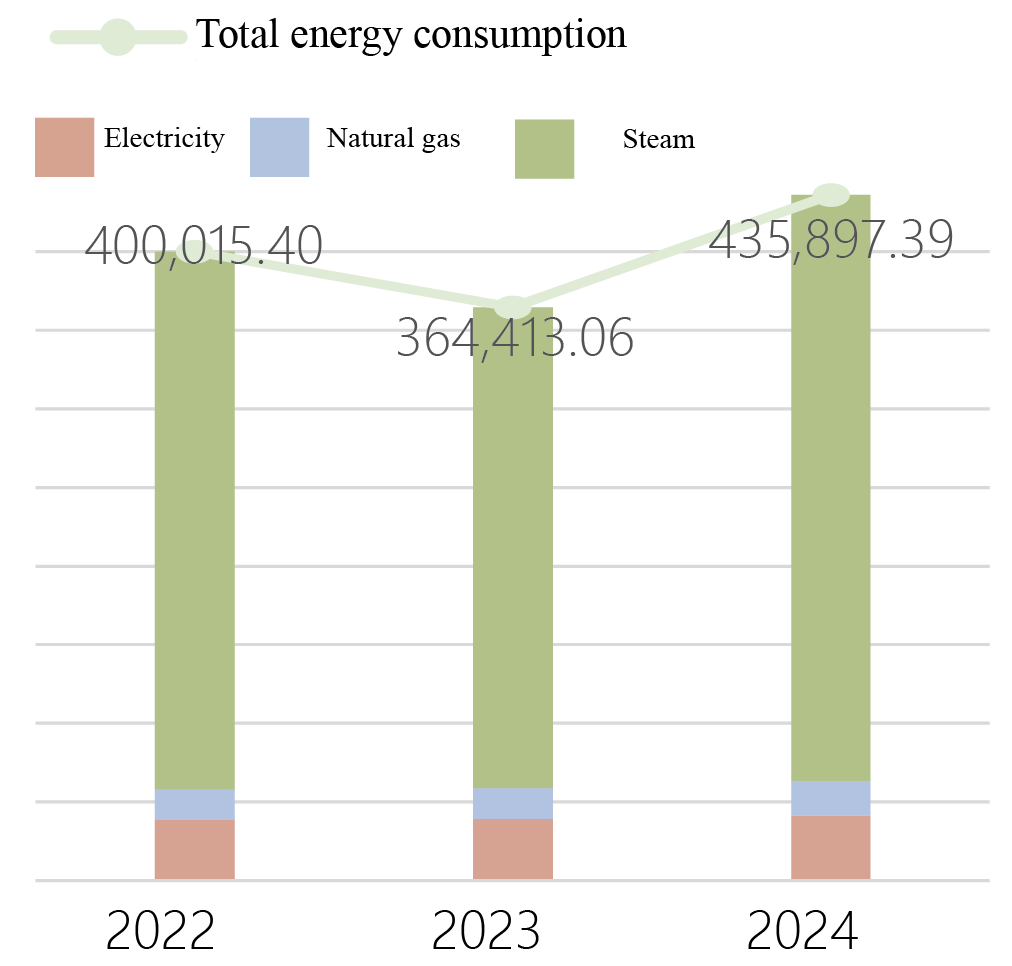
The energy consumption of AGV in the most recent three years is shown in the table below:
| Quantitative metric | Unit | 2022 | 2023 | 2024 |
| Electricity consumption | kWh/year | 10,788,451 | 10,894,715 | 11,473,645 |
| GJ | 38,838.42 | 39,220.97 | 41,305.12 | |
| Natural gas (LNG) Amount consumed | m³ | 571,421 | 587,097 | 650,471 |
| GJ | 19,126.60 | 19,651.31 | 21,772.57 | |
| Steam consumption | Tonnes/year | 20,438 | 20,285 | 21,888 |
| GJ | 342,050.37 | 305,540.78 | 372,819.70 | |
| Value of specific metric used by the organization (Turnover) | NTD1,000,000 | 4,014.23 | 4,052.61 | 4,207.30 |
| Total energy consumption | GJ | 400,015.40 | 364,413.06 | 435,897.39 |
| Energy intensity | GJ/NTD1,000,000 | 99.65 | 89.92 | 103.61 |
Note: 1. The coefficient of steam calorific value is provided by Shih Hua Energy Co., Ltd. 2. The heat value of electricity is calculated as 1 kWh = 0.0036 GJ. 3. The conversion factor is based on the fuel heat value calculated according to the EPA’s Gas Emission Factors Management Table version 6.0.4; 8,000 kcal/m3 for natural gas; 1 kcal = 4.184 KJ. | ||||
Performance in Energy Conservation GRI 302-4 GRI 302-5
We have adopted the following action plans to reduce energy consumption to contribute to the green environment. As of now, AGV has been focusing on the current methods for management of energy emissions:
1. The old air compressor was replaced with a 10HP IE3 air compressor, reducing energy consumption by 2HP and improving equipment efficiency. The daily calculation is: 1.49kW * 24h = 35.76kW/day, and the total annual electricity consumption is calculated as: 35.76kW/day * 365 = 13,052.4kW/day, resulting in an energy savings of 47 GJ.
2. Replaced the old light tubes in Food Factory 1 with 160 LED light tubes, reducing power consumption.
3. The production line’s air blow pipes were replaced with 110 energy-saving nozzles to more effectively dry water droplets from the bodies, improving drying efficiency and achieving energy conservation.
4. Recycling cleaner treated water, which is stored and pressurized and then made available to the factories for road cleaning, toilet flushes and irrigation.
| Recycled Water Reused by AGV in 2024之情形 | |
| Measures and practices for water treatment | Actual amount of water recycled and reused |
| Recycling cleaner treated water, which is stored and pressurized and then made available to the factories for road cleaning, toilet flushes and irrigation. | 11,536 tonnes of recycled water from January to December 2024 |
Water resource management GRI 303-1
AGV is highly reliant on water during the product manufacturing process. In addition, the distribution of water resources in Taiwan is uneven, and extreme weather has become a more frequent occurrence which constantly causes rainstorms and water shortages, exacerbating the complexity of water resource management. We consider water resources to be an important environmental and operational issue, and are committed to enhancing our adaptation capabilities in relation to water resource management. The headquarters of AGV is located in Chiayi County, and the main sources of its water supply are the Tsengwen Reservoir, Wushantou Reservoir, Renyitan Reservoir, Lantan Reservoir and Yunlin Hushan Reservoir. In order to effectively manage its water resources, AGV has used a water resource risk assessment tool, with the result of assessment indicating that its water resource risks are all moderate-to-low risks.
In terms of water resource management, we have long been concerned about the issues of water resources, energy conservation and environmental protection. Regarding our water conservation programs, we will start with water saving in our daily lives, and we will hold regular meetings to discuss issues related to water resources, formulate policies to make active improvements to the amount of water consumed in our manufacturing processes, review our performance in water conservation on a monthly basis, and promote water conservation through posters, slogans and training courses to enhance the effectiveness of our available water resources.
| Location of headquarters | Reservoir as source of water withdrawal | Result of assessment |
| Minxiong Township, Chiayi County | Yunlin Hushan Reservoir | Moderate-to-low risks |
| Renyitan Reservoir | ||
| Wushantou Reservoir | ||
| Lantan Reservoir | ||
| Tsengwen Reservoir |
| Water used by AGV | |||
| Year | 2022 | 2023 | 2024 |
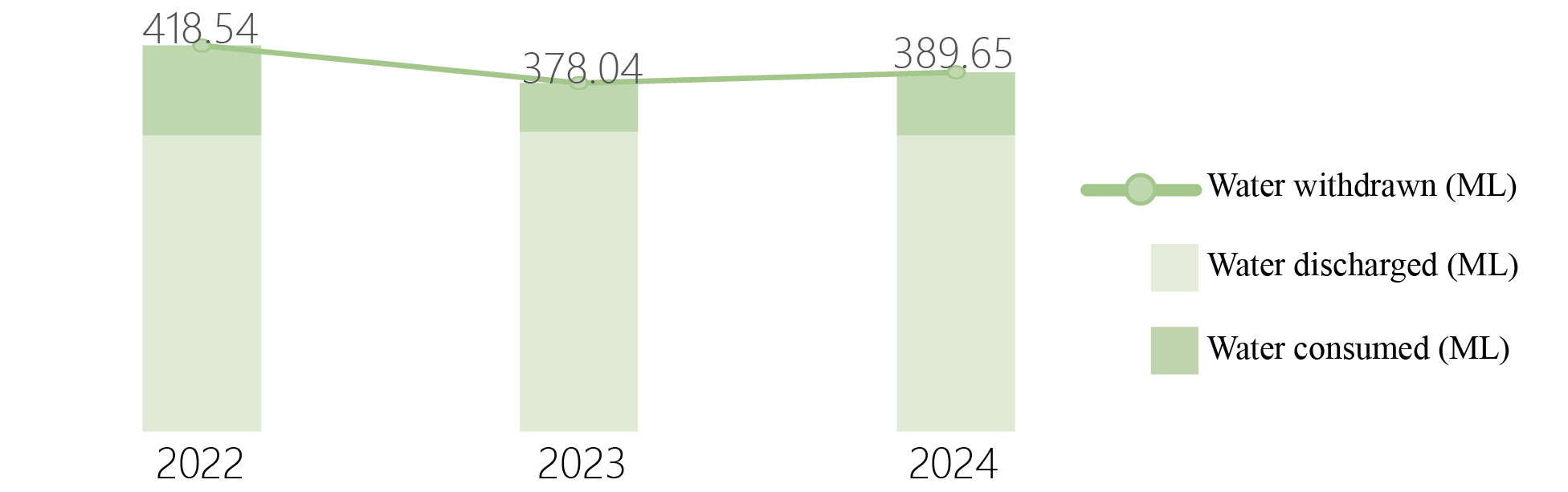
| Water withdrawn (ML) | 418.54 | 378.04 | 389.65 |
| Water discharged (ML) | 321.16 | 325.31 | 321.39 |
| Water consumed (ML) | 97.38 | 52.73 | 68.26 |
| Value of specific metric used by the organization (sales in NTD million) | 4,014.23 | 4,052.61 | 4,207.30 |
| Water intensity | 0.10 | 0.09 | 0.09 |
| Note: 1. Water consumed = Water withdrawn - Water discharged. 2. Water use intensity is calculated as: Water withdrawn (ML)/Specific metric used by the organization. 3. Locations examined include: Chiayi headquarters, Chiayi dormitory on Jiangwen Street, Chiayi Lianton Building, Taipei office, and sales offices (Sanchong, Xindian, Taoyuan, Hsinchu, | |||
Discharge of Wastewater GRI 303-2
For wastewater discharged by AGV, we have set up a continuous monitoring system as required by the Environmental Protection Bureau, and have reported its water pollution control measures as required by the Environmental Protection Bureau to obtain a certificate of discharge permit. The quality of wastewater monitored with the relevant equipment fully conforms with the effluent standards established by the Environmental Protection Administration. The water temperature, pH, SS, COD, BOD5 and oil content of the treated wastewater under 24-hour continuous monitoring did not exceed the criteria.| Testing item | Unit | 2022 | 2023 | 2024 | |||
| Emission criteria | Annual average monitoring value | Emission criteria | Annual average monitoring value | Emission criteria | Annual average monitoring value | ||
| Water temperature | ℃ | 35 | 27.975 | 35 | 31.025 | 35 | 29.875 |
| pH | pH | 9 | 7.800 | 6-9 | 7.750 | 6-9 | 7.7 |
| Suspended solids (SS) | mg/L | 30 | 3.325 | 30 | 4.475 | 30 | 4.625 |
| Chemical oxygen demand (COD) | mg/L | 100 | 17.175 | 100 | 24.350 | 100 | 18.475 |
| Biochemical oxygen demand (BOD5)5) | mg/L | 30 | 6.225 | 30 | 5.425 | 30 | 3.925 |
| Oil | mg/L | 10 | 0.775 | 10 | 1.725 | 10 | 1.8 |
Management of GHG Emissions GRI 305-1 GRI 305-2 GRI 305-3 GRI 305-4 GRI 305-5
According to the Roadmap for Sustainable Development of Listed Companies, the parent company began its inventory in 2023, and the subsidiaries included in the consolidated financial statements began theirs in 2024. The consolidated company has established a greenhouse gas inventory mechanism based on the ISO 14064-1 greenhouse gas inventory standard issued by the International Organization for Standardization (ISO). Since 2014, we have regularly inventoried GHG emissions annually to track the use and emission of GHGs. The total GHG emissions of the Company and all subsidiaries included in the consolidated financial statements are as follows:| Item | Emission Sources | 2023 | 2024 | |
| The Company | Scope 1 | • Category 1: Direct Emissions: Fixed combustion emission sources, mobile combustion emission sources, fugitive emissions | 1,762 | 1,693 |
| Scope 2 | • Category 2: Energy Indirect Emissions: Electricity, steam | 5,972 | 5,442 | |
| Scope 3 | • Category 3: Transportation Indirect Emissions: Employee commuting | 213 | 210 | |
| • Category 4: Raw Material / Service Indirect Emissions: Upstream procurement of energy and fuels, waste disposal and recycling | 2,106 | 1,574 | ||
| Subtotal | 10,053 | 8,920 | ||
| All subsidiaries included in the consolidated financial statements | Scope 1 | • Category 1: Direct Emissions: Fixed combustion emission sources, mobile combustion emission sources, fugitive emissions | – | 2,004 |
| Scope 2 | • Category 2: Energy Indirect Emissions: Electricity, steam | – | 2,753 | |
| Scope 3 | • Category 3: Transportation Indirect Emissions: Employee commuting | – | 222 | |
| • Category 4: Raw Material / Service Indirect Emissions: Upstream procurement of energy and fuels, waste disposal and recycling | – | 1,031 | ||
| Subtotal | – | 6,011 | ||
| Total | 10,053 | 14,930 |
Note:
1. Inventory Boundary:
The Company:Chiayi headquarters, Chiayi dormitory on Jiangwen Street, Chiayi Lianton Building, Taipei office, and sales offices (Sanchong, Xindian, Taoyuan, Hsinchu,
Subsidiaries: Hope Choice Distribution Corp, Aco Distribution Corp, Hopeland Distribution Corp, Aiken Biotechnology International Co., Ltd, Sontenkan Resort Development Co.,Ltd, Defender Private Security Inc, Yunlin Dairy Technology Corp, Shandong Agv Food Technology Co., Ltd, Shanghai Agv Foods Co., Ltd, Xiamen Aijian Traders Co., Ltd, Asia Pacific Product Development Corporation.
2. Types of GHG emissions: CO2, CH4, N2O, and HFCs.
• GHG reduction baseline year and targets:
With 2023 as the base year, the short-term goal is to reduce greenhouse gas emissions by 1% annually, with a projected reduction of 3% by 2025 and 5% by 2030.
• GHG reduction strategies and specific action plans
With 2023 as the base year, to understand the status of our GHG emissions, an inventory of our internal GHG emissions is considered fundamental to carbon management. A GHG inventory may not only verify the accurate amount of emissions but also help find room and opportunities for reduction. In 2024, a company-wide carbon emissions inventory will be conducted to facilitate subsequent improvements to the largest emission sources.
• Status of reduction target achievement:
Based on the results of the 2023 GHG inventory, the Company has planned several equipment upgrade and replacement solutions to improve performance and reduce carbon emissions.
GRI 305-6 GRI 305-7 During the 2024 reporting period, AGV did not emit any ozone depleting substances. The following table shows the items for testing of AGV’s boilers from 2022 to 2024.| Type of boiler | Testing item | 2022 | 2023 | 2024 | ||||||
| Emission (kg) | Emission criteria (ppm) | Annual average monitoring value (ppm) | Emission (kg) | Emission criteria (ppm) | Annual average monitoring value (ppm) | Emission (kg) | Emission criteria (ppm) | Annual average monitoring value (ppm) | ||
| Natural gas boiler | Aggregate | 27.43 | 30 | 0 | 28.17 | 30 | 0.0064 | 31.23 | 30 | 0.00834 |
| SOx | 0 | 50 | 0 | 0 | 50 | 0 | 0 | 50 | 0 | |
| NOx | 1,281.70 | 100 | 0.2 | 1316.72 | 100 | 0.28 | 1,459.05 | 100 | 0.44 | |
| Note: 1. Major gases such as nitrogen oxides (NOx), sulfur oxides (SOx), persistent organic pollutants (POPs), volatile organic compounds (VOC), hazardous air pollutants (HAP), particulate matter (PM) and other standard types of gas emissions specified in the relevant laws and regulations. Among them, the items of sulfur oxides (SOx), persistent organic pollutants (POPs), volatile organic compounds (VOC), hazardous air pollutants (HAP) and particulate matter (PM) are not applicable to the testing of our boilers. 2. Unit of annual average monitoring value: KG/HR. | ||||||||||
Waste management GRI 306-1 GRI 306-2
Attaching great importance to the prevention of pollution, AGV remains committed to a belief in green environmental protection. In addition to complying with relevant laws and regulations, AGV has contracted legal companies to assist in the removal of waste, and kept statistics of the types of waste to sort, including those that can be recycled and reused in order to reduce unnecessary expense for waste removal. We comply with laws and regulations governing waste, and we submit reports online, print out triplicate forms, and track proper certifications as required by law in relation to waste treatment. We sign a contract with the company contracted for removal and treatment, check the expiry date of the license of the company contracted for removal and treatment, and conduct regular on-site audits of the treatment plant annually, with records of such audits kept.
With 2023 as the base year, we expect to achieve recycling and sustainable use of resources via the environmental protection policy of “3R,” namely “reduce,” “recycle” and “reuse,” in order to mitigate environmental damage and pollution.
• Short-term goal: Our set target is to reduce the amount of waste by 1–3% per year, and we expect to reduce the total amount of waste by 5% by 2025.
• Mid- to long-term targets (after 2025):
1. Building an eco-friendly and energy-saving environment.
2. Following our waste recycling and sorting management policy, with all of our employees participating in waste recycling and sorting.
We follow the “Waste Disposal Act” for implementation and continuous monitoring and improvement. Our waste is mainly sorted into “general industrial waste” and “recyclable waste”, and our focus is on the sorting and management of general industrial waste and recyclable waste to ensure they do not cause any pollution to environmental health or affect human health.
GRI 306-3 GRI 306-4 GRI 306-5 GRI 306-3(2016)Waste recycling has been a long-term goal we strive to achieve. For waste management, we engage in factory-wide inventory and sorting and propose improvement strategies to set reduction targets.
| To do our part for the planet, we also seek to strengthen the reduction of use of raw materials and the reduction and re-use of waste. In 2024, no serious leakage occurred at AGV. | ||||
| Waste produced and treated by AGV | Hazardous/Non- hazardous | Off-site | ||
| Item | Treatment method | 2023年 | 2024年 | |
| Sludge and waste cooking oil | Non-hazardous | Re-use and incineration | 1,249.1 | 999.4 |
| Vegetable residue | Non-hazardous | Other treatment method (composting) | 530.8 | 446.8 |
| Garbage and sludge | Non-hazardous | Incineration (excluding energy recycling) | 473.6 | 540.6 |
| Waste paper, bottles, etc. | Non-hazardous | Other recycling method | 364.9 | 377.2 |
| Note: 1. No hazardous waste. 2. Inventory boundary: AGV Headquarters. | ||||


 English
  繁體中文
繁體中文